










Nicola Trivett
General Manager & Sustainability Leader
Clients ask me this question more often than almost any other. What is a green fit-out, and is it really different from the fit-out they would get anyway?
It is a fair question. After all, both approaches end with a finished office, fresh finishes and a team moving in on day one.
The real difference sits in the decisions you cannot see. A green fit-out changes what goes into a space, what comes out of it and how that space performs for years after handover.
In this guide, I explain what a green fit-out means in practice and how it compares with a standard fit-out. I also cover the UAE standards that shape the process and share what we learned delivering The NEST for Schneider Electric in Dubai.
What Is a Green Fit-Out?
A green fit-out is an interior fit-out that is designed and built to reduce environmental impact and improve the health of the people who use the space. It does this through careful material choices, efficient systems, waste diversion and good indoor air quality. The results are measured, and they are often verified against a recognised standard such as LEED or WELL.
In other words, a green fit-out is not a style. You cannot spot one by the number of plants in reception. It is a way of making decisions, and it starts long before anyone picks a finish.
At Summertown, we build every green fit-out around four simple principles.
- First, we reuse before we replace.
- Second, we specify materials that are low impact and healthy to live with.
- Third, we design systems that use less energy and water once the space is occupied.
- Finally, we measure what we do, so the results stand up to scrutiny.
Why does this matter so much?
The answer lies in the scale of the built environment’s footprint. According to the UN Environment Programme’s latest Global Status Report, the buildings and construction sector uses 32% of global energy and produces 34% of global CO2 emissions. UNEP’s Executive Director, Inger Andersen, has also noted that the buildings where we live and work account for around a third of global waste. Interiors are a big part of that story, because offices are refitted far more often than buildings are rebuilt.
There is a human side too. The US Environmental Protection Agency reports that people spend roughly 90% of their time indoors, where some pollutants can reach concentrations 2 to 5 times higher than outdoors. The materials and systems in a fit-out directly shape the air your team breathes every day.
What Does a Standard Fit-Out Usually Involve?
To understand the difference, it helps to start with the familiar process. In the UAE, most commercial fit-outs follow two stages.
Category A (Cat A) is the base level that a landlord typically delivers. It usually covers raised floors, suspended ceilings, basic lighting and core mechanical and electrical services. The result is a clean, functional shell.
Category B (Cat B) is where the tenant makes the space their own. This stage includes partitions, meeting rooms, finishes, joinery, furniture, pantries, AV and IT. Most of the decisions that affect sustainability happen here.
A standard fit-out focuses on three priorities: Price, programme and appearance. Those priorities are perfectly valid. However, sustainability rarely appears in the brief. As a result, the existing fit-out is usually stripped out and sent to landfill, materials are chosen mainly on cost and availability, and systems are designed to meet the minimum code. Once the team moves in, nobody measures how the space actually performs.
None of this makes a standard fit-out bad work. Many are beautifully finished. The issue is that the long-term costs and impacts simply sit outside the scope.
Green Fit-Out vs Standard Fit-Out: What Actually Changes?
The table below gives a quick overview. After that, I walk through each stage in more detail.
| Stage | Standard fit-out | Green fit-out |
|---|---|---|
| Brief | Cost, programme and look | Adds clear environmental and wellbeing targets |
| Strip-out | Existing items removed and discarded | Existing items audited, reused or recycled |
| Materials | Chosen mainly on price and availability | Chosen for low emissions, durability and recycled content |
| Systems | Designed to minimum code | Designed for efficient operation and comfort |
| Air quality | Rarely tested | Planned, controlled and often tested |
| Results | Not measured | Tracked, reported and often certified |
The Brief
Everything starts here. In a green fit-out, sustainability targets sit alongside budget and brief from the very first meeting. That might mean a certification target, a waste diversion goal or a commitment to healthier materials.
This early alignment matters more than any single product choice. When the designer, project manager and contractor share the same goals, the whole team makes better decisions. When sustainability arrives halfway through the project, it usually becomes an expensive add-on.
Strip-Out and Waste
This is where the gap between the two approaches is easiest to see. On a standard project, the old fit-out often goes straight into a skip. On a green project, we audit what already exists before demolition starts.
Glass partitions, ductwork, HVAC units, cabling and furniture often have plenty of life left. We plan how to reuse them on site, redirect them to other projects or recycle them properly. Then we track every load, so the results are real numbers rather than estimates. We share more about this approach in From Waste to Worth: Repurposing Materials in Office Fit-Outs.
Materials
Material choices shape both the carbon footprint of a space and the health of the people in it. In a green fit-out, we look for products with low chemical emissions, recycled or responsibly sourced content, and verified environmental data.
Durability matters just as much. A cheaper finish that needs replacing in three years is rarely the greener or the smarter choice. For a deeper look at specification, read our Green Building Materials Guide for Sustainable Office Fit-Outs.
Lighting, Cooling and Energy
In the UAE climate, cooling is a major driver of energy use. A green fit-out therefore pays close attention to how the space is zoned, cooled and lit.
That usually means efficient LED lighting with smart controls, sensible HVAC zoning and layouts that make the most of natural daylight. Meeting rooms that sit empty for half the day should not be cooled and lit as if they were full. These choices are invisible to visitors, yet they shape your utility bills for the entire lease.
Indoor Air Quality and Wellbeing
A green fit-out treats the people in the space as a priority, not an afterthought. We specify low-emitting paints, adhesives, sealants and furniture. We also plan ventilation, filtration and acoustic comfort with care.
Biophilic design often plays a part too. Natural textures, planting and good views help people feel calmer and more focused. Most importantly, the design supports the way your team actually works, from quiet focus to busy collaboration.
Measurement and Certification
This is the final and most important difference. A standard fit-out ends at handover. A green fit-out proves its results.
We track waste, materials and performance throughout the project. Many clients then choose to certify their space under a recognised standard. Certification gives independent proof of your claims, which matters more each year as stakeholders look harder at ESG reporting.
A Green Fit-Out in Practice: The NEST for Schneider Electric
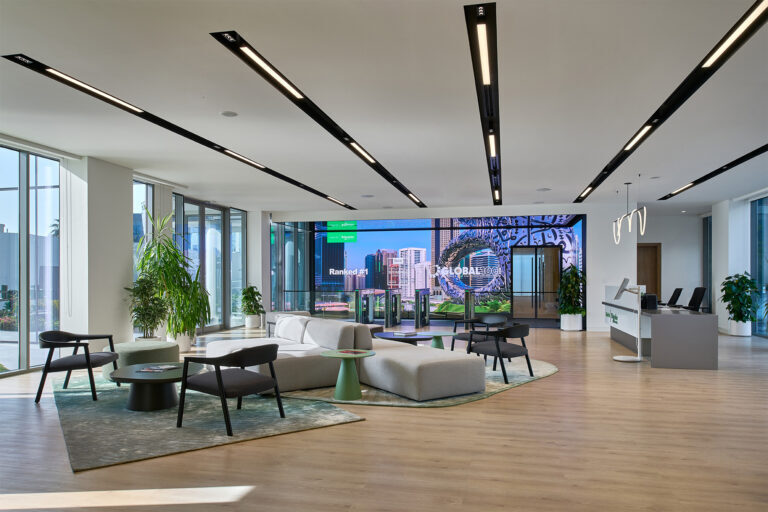
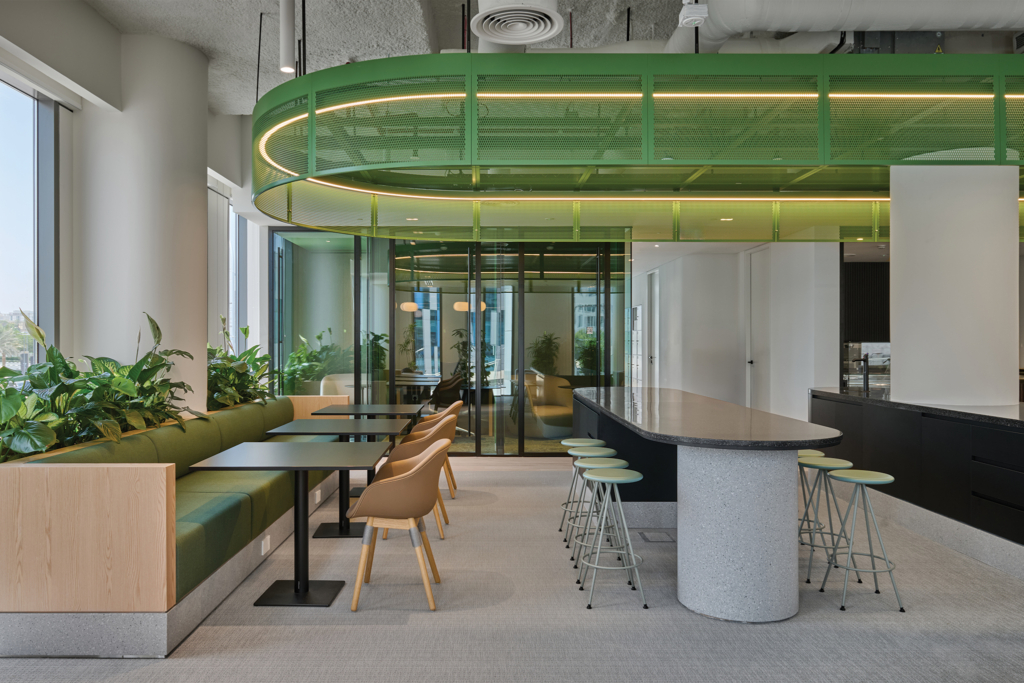
The best way to explain a green fit-out is to show one. When Schneider Electric asked us to refurbish their offices in Dubai Silicon Oasis, the brief went far beyond a new look. The company wanted a high-performing workplace that reflected its ESG commitments.
We worked alongside JLL MENA as project managers and Gensler as lead designers. Our scope covered two full floors, including bespoke joinery, a data centre, a training hub and the Schneider Electric Innovation Hub.
From day one, we planned for reuse. We audited existing materials, coordinated with suppliers and tracked every kilogram through a detailed Waste and Logistics Plan. Existing HVAC units were assessed, serviced and reinstalled. Aluminium and glass partitions were carefully dismantled and reused. Items we could not use on site went to other UAE projects.
The results speak for themselves. Of the 10,759 kg of construction waste the project generated, 10,049 kg was recycled or reused. That represents 93% diversion from landfill. The space was also designed to target LEED Platinum and WELL certification, with low-VOC materials, enhanced filtration and acoustic treatments throughout.
In December 2025, The NEST won Sustainable Project of the Year at the Design Middle East Awards. You can read the full award story here and the detailed circular fit-out case study here.
For me, the lesson is simple. The NEST was delivered with the same professional standards as any other project. The difference was the thinking behind every decision.
Does a Green Fit-Out Cost More?
This is usually the next question, and it deserves an honest answer. Some green specifications cost more upfront. Others cost less, especially when you reuse existing items instead of buying new ones.
The bigger picture is about the whole life of the space. Efficient systems reduce running costs, durable materials last longer and healthier spaces support the people who use them. I explore the numbers in detail in Sustainable Office Fit-Outs vs Traditional Fit-Outs in the UAE, so I will not repeat them here.
If you want a quick estimate for your own commercial fit-out project, try our LEED ROI calculator. We also provide free LEED Certified-level certification for fit-out projects over 2,000 sqm. This removes one of the most common barriers to formal certification.
Which Green Building Standards Apply in the UAE?
The UAE has a strong framework for green building, and several standards can shape your fit-out. Some are voluntary international benchmarks. Others are local regulations.
LEED is the most widely recognised international rating system. The US Green Building Council launched LEED v5 on 28 April 2025, with registration open for Interior Design and Construction projects. Under v5, decarbonisation accounts for half of all available points. Our complete guide to LEED certification in Dubai explains how the process works step by step.
WELL focuses on human health rather than environmental performance. Developed by the International WELL Building Institute, it is structured around ten concepts: Air, water, nourishment, light, movement, thermal comfort, sound, materials, mind and community. Many of our clients pursue LEED and WELL together.
Locally, Dubai and Abu Dhabi each have their own systems.
In Dubai, Al Sa’fat sets mandatory requirements for all new buildings to achieve the Silver Sa’fa, with Gold and Platinum available for higher performance.
In Abu Dhabi, the Estidama Pearl Rating System requires all new projects to achieve at least 1 Pearl, while government-funded buildings must reach 2 Pearls. These codes apply to whole buildings, so a fit-out needs to work within them and support the base building’s performance.
All of this sits within a wider national goal. The UAE announced its Net Zero by 2050 Strategic Initiative in October 2021, becoming the first nation in the Middle East and North Africa to set such a target. The country’s Net Zero 2050 Strategy now includes buildings as one of six key sectors. In practice, the direction of travel is clear. Standards will keep rising, and a green fit-out helps future-proof your space against that change.
Is a Green Fit-Out Right for Your Business?
In my experience, a green fit-out suits almost every commercial project. However, it brings the greatest value in a few situations.
It makes particular sense if your organisation reports on ESG targets or has made public climate commitments. It also suits businesses that compete for talent, because people increasingly care about where they work. Finally, it is a smart choice for anyone planning a long lease, since efficiency savings build up over time.
Timing is the key to success.
The earlier sustainability enters the conversation, the more options you keep open. Once the design is fixed and orders are placed, many of the best opportunities are gone. Our guide to planning a sustainable office fit-out in Dubai covers this early stage in detail.
When you speak to potential contractors, ask a few direct questions. How do they handle strip-out waste, and can they show you the figures? Which certifications have they delivered? How do they verify material emissions? A confident partner will answer with evidence, not slogans.
Building Better Spaces, One Decision at a Time
A green fit-out does not look dramatically different on day one. The difference shows up over time: In the waste that never reached landfill, the energy your systems no longer waste and the air your team breathes every day.
For over 28 years, Summertown has delivered fit-outs across Dubai and Abu Dhabi. Today, sustainability shapes every project we take on. If you are planning your next office, we would love to help you explore what a green fit-out could look like for your business.
Contact our team to start the conversation, or explore our Sustainability Hub to learn more about our approach.
Frequently Asked Questions
- Is a green fit-out the same as a sustainable fit-out? Yes, in most cases the two terms mean the same thing. Both describe a fit-out designed to reduce environmental impact and support occupant health. Some people use “sustainable” to suggest a broader scope that includes social and economic factors as well.
- Does a green fit-out take longer? Not necessarily. Planning takes a little more care at the start, especially for material audits and certification targets. However, good planning often prevents delays later in the project.
- Can I have a green fit-out without certification? Absolutely. Many green principles, such as reuse, healthy materials and efficient lighting, bring benefits on their own. That said, certification gives you independent proof, which is valuable for ESG reporting and brand reputation.
- Can an existing office be refitted as a green fit-out? Yes, and refurbishment is often the greenest option of all. Reusing what already works avoids the carbon and waste of replacing it. The NEST is a good example of this approach in action.
Sources:
- UNEP: Global Status Report for Buildings and Construction 2024/2025
- UNEP figures on buildings and waste
- US EPA: Indoor Air Quality
- LEED v5
- Stantec: WELL Building Standard
- Dubai Municipality: Al Sa’fat
- Abu Dhabi DMT: Estidama Pearl Rating System
- Dubai Media Office: UAE Net Zero 2050
- u.ae: The UAE Net Zero 2050 Strategy
- Summertown: Circular Office Fit-Out case study
- Summertown: Design Middle East Awards 2025

Nicola Trivett
General Manager & Sustainability Leader